
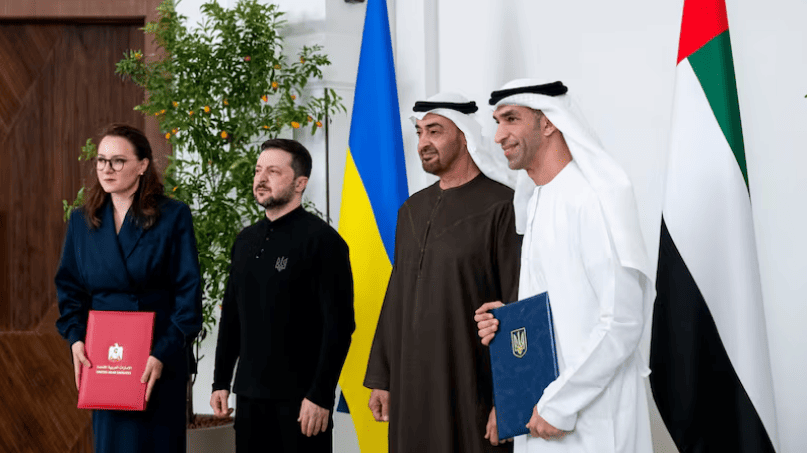
The UAE and Ukraine officially signed a Comprehensive Economic Partnership Agreement on Monday, seeking to strengthen trade and investment ties. The agreement was signed by Dr. Thani Al Zeyoudi, Minister of State for Foreign Trade, and Yulia Svyrydenko, First Deputy Prime Minister and Minister of Economy of Ukraine, in the presence of His Highness Sheikh Mohamed bin Zayed Al Nahyan, President of the UAE, and Ukrainian President Volodymyr Zelensky, reported by The National News.
Sheikh Mohamed also held talks with Mr. Zelensky in Abu Dhabi as part of the latter’s official visit to the Emirates. The two leaders sought ways to strengthen the partnership in key areas such as the economy, investment, development, renewable energy and food security.
Comprehensive Economic Partnership Agreements
The Comprehensive Economic Partnership Agreements (The Cepa) are expected to contribute about $369 million to the UAE’s GDP and $874 million to the Ukrainian economy by 2031. Under the terms of the agreement, 99% of Ukrainian imports of goods from the UAE and 97% of Ukrainian exports to the Emirates will be duty-free with immediate effect. As of 2021, the UAE is Ukraine’s second-largest trading partner in the Gulf region, and non-oil trade between the two countries exceeded $388 million in 2022, according to data from the Ministry of Economy.
The Cepa is also expected to help accelerate the economic recovery of Ukraine, which is fighting a war with Russia, which will enter its fourth year on February 25. “Today, an important economic agreement was signed between our countries,” President Zelensky said in a post on X. The agreement liberalizes access to the UAE market for almost all Ukrainian goods. This will make it easier for Ukrainian companies to sell their products in the UAE.
UAE deepens ties with trading partners
The UAE, which has set a goal of achieving 4 trillion dirhams in foreign trade by 2031 as part of its national economic goals, is developing non-oil sectors and deepening ties with trading partners to strengthen long-term growth prospects.
The Arab world’s second-largest economy and the region’s tourism and financial hub has also invested heavily in trade and logistics infrastructure, including modern seaports and airport infrastructure, to attract foreign investors.