
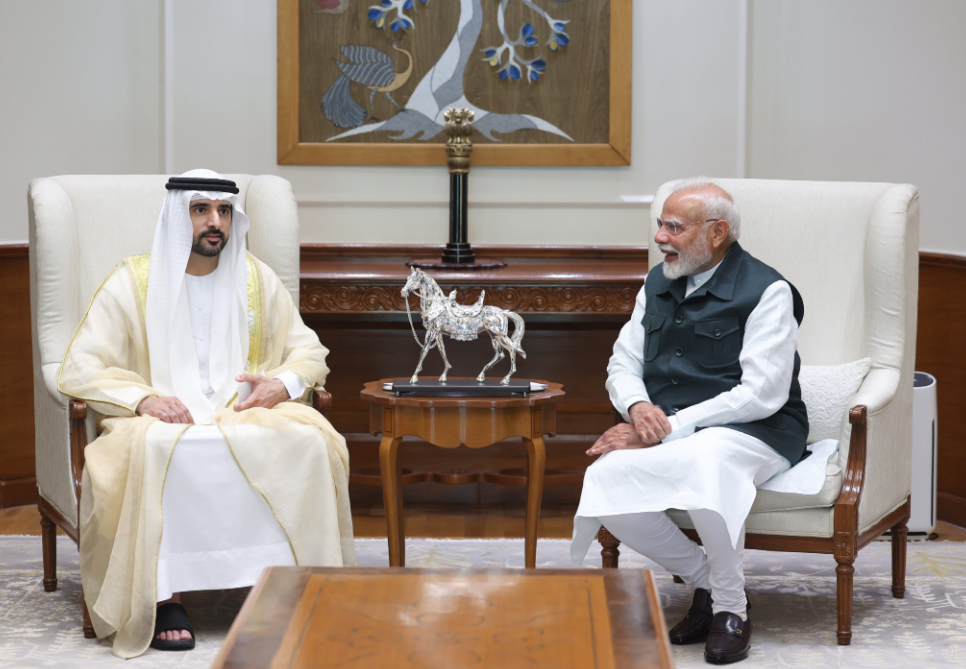
The crown prince of Dubai, Sheikh Hamdan bin Mohammed bin Rashid Al-Maktoum, arrived in New Delhi on Tuesday with a ministerial and corporate entourage that underscores the UAE‘s aggressive repositioning in the world’s largest and fastest-growing economy. His two-day programme includes meetings with Prime Minister Narendra Modi, the defence and foreign ministers, and a business forum in Mumbai, where around 200 C-suite executives are expected to attend. For Abu Dhabi, this is the first visit of this level since the CEPA agreement came into force in 2022, which has already reduced tariffs on 90% of goods and pushed bilateral trade to $45.4 billion in 2023, while non-oil and gas trade reached $54.2 billion — a new record, Arabnews has reported.
According to DubaiMediaOffice, Indian investments in the emirate exceeded $3 billion last year, and the resident register was replenished by another 8,000 companies from the Subcontinent, bringing their number to 70,000. Dubai is seeking to turn this capital into “fast money” for the national economic diversification program: the delegation includes top managers from ADQ, DPWorld and DubaiChambers, who are promoting joint projects in the fields of fintech, clean energy and agro-logistics. Amid a global overhaul of supply chains, the emirate is betting that its tax-free jurisdiction and port infrastructure will become a gateway for Indian corporations to Africa and the Middle East.
India’s economic ties with Dubai
Sheikh Hamdan has already outlined three priorities for the talks: expanding trade quotas under CEPA-2.0, joint investments in hydrogen energy, and integrating payment systems that would reduce transaction costs by 20% for exporters in both countries. In Mumbai, he will open the DubaiChambers business forum, where ADQ will present a new $1 billion fund to invest in Indian AI startups, and DPWorld will discuss the expansion of container terminals in NhavaSheva and Kochi. At the same time, Mubadala is conducting due diligence on participating in the IndiaMiddleEastEuropeEconomicCorridor (IMEC) project, which could reduce the time it takes to deliver goods to Europe by ten days.
The stakes are high for Dubai: the Indian diaspora, the largest in the UAE, already sends home more than $17 billion a year; by channeling these flows through Dubai’s financial hubs, the emirate is strengthening its role as a regional “clearing house” for the rupee. For its part, New Delhi is seeking quick access to Emirati capital to finance a $1 trillion plan to invest in digital and green infrastructure by 2030. Both capitals see joint access to African and Southeast Asian markets as a natural extension of CEPA, with the UAE offering preferential loans to exporters through the Emirates Development Bank.
Sheikh Hamdan meets Rajnath Singh
As Indian Defense Minister Rajnath Singh noted after meeting Sheikh Hamdan, the parties are preparing a framework agreement on joint production of unmanned systems and exchange of defense technologies—a step that could open up access to the Make-in-India program in the defense sector for Emirati investors. In the financial sphere, Dubai Financial Market and Bombay Stock Exchange are discussing a “listing gateway” that would allow Emirati companies to conduct dual-listing in India and vice versa, reducing regulatory arbitrage.
The trip will culminate in a roundtable in Mumbai, where the Sheikh will present the concept of the Dubai-India Growth Corridor—a network of industrial zones from Jebel Ali to Gujarat, focused on high-tech manufacturing and green hydrogen. The plan includes a pilot project of a smart portal that integrates customs and logistics services in real time and promises to reduce cargo clearance time from 72 to 24 hours. According to DubaiChambers, this could add at least $8 billion to bilateral trade by 2026. If the initiative gains momentum, the emirate will gain not just another sales market, but an “extended production pipeline” for its post-oil transformation strategy.