
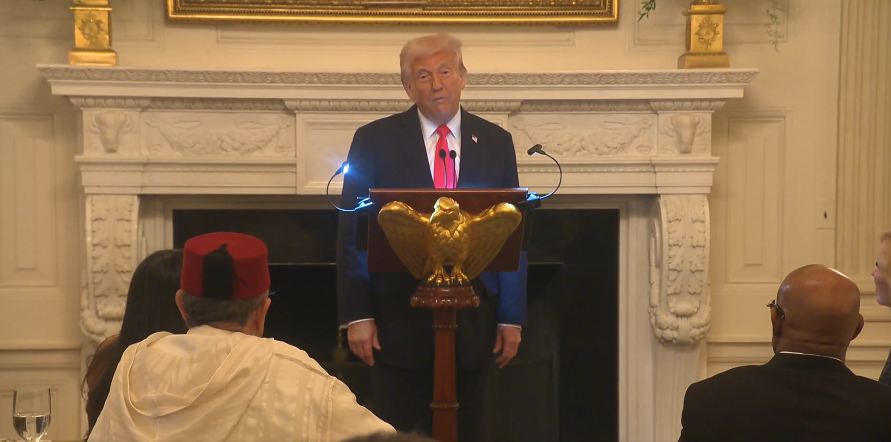
On Thursday, US President Donald Trump hosted a traditional iftar at the White House, using the occasion to thank American Muslims for their support in the 2024 elections, The National has reported. Speaking to the audience, he pointedly pointed to the importance of this electoral group: “The Muslim community was with us in November — and as long as I am president, I will be with you.” The words came at a time when the Trump campaign is increasingly rethinking its position in the context of the Middle East and Muslim communities in the US — especially in battleground states such as Michigan and Arizona, where the voice of Arab-American voters could be decisive.
In the shadow of this diplomatic dinner is Massad Boulos, Trump’s influential adviser on Middle East issues and father-in-law of his daughter Tiffany. His active engagement with Muslim leaders and attempts to formulate a peace agenda have become key elements of Trump’s foreign policy image. However, despite the stated ambitions for a quick end to the conflicts, the promises remain mostly declarative. Such a tension between public assurances and geopolitical realities only enhances the symbolic weight of the event, where religious tradition becomes part of the strategic narrative.
Iftar at the White House: Ramadan diplomacy
Among the guests of the iftar are representatives of diplomatic missions from the UAE, Jordan, Qatar, Egypt, Bahrain, Oman and a number of other countries. In the presence of a large Arab delegation, Trump did not miss the opportunity to once again emphasize the importance of the Abraham Accords, concluded during his first presidency: “These agreements are something that everyone thought was impossible. And we did it. Now is the time to fill them with concrete,” he said, while criticizing his predecessor, Joe Biden, for his alleged inaction on the issue.
The 2020 agreement between the UAE, Bahrain and Israel — and the subsequent accession of Sudan and Morocco — was one of the Trump administration’s biggest foreign policy breakthroughs. Amid new regional challenges and the difficult situation in Gaza, the White House is trying to step up communication with Gulf partners to maintain at least the appearance of a strategy for regional stability.
Princess Reema bint Bandar Al Saud, Saudi Arabia’s ambassador to the United States, received special attention at the iftar, whom Trump called a “special woman.” The gesture demonstrates a delicate balance — combining diplomatic protocol with the personal accents inherent in the former president’s political style.
Iftar as a tool of soft power in times of conflict
The ceremonial dinner took place against the backdrop of an escalation in the Gaza Strip, where Israel resumed active hostilities after violating the January truce. In this context, the idea voiced by the Trump team — to turn Gaza into a conditional “Riviera” by resettling part of the population to Egypt and Jordan — is perceived in the region not only with distrust, but also with a sharply negative reaction. The proposal, which sounds like an infrastructure project, is actually perceived as an attempt to rethink the geopolitical map without taking into account the complex humanitarian reality.
Nevertheless, the iftar at the White House performs an important function — not only religious and cultural, but also diplomatic. In an era when public gestures have no less weight than intergovernmental agreements, such events become part of a broader strategy: soft power combined with electoral calculation. Trump seeks to present himself as a leader in dialogue with the Muslim world, and although declarations are not always backed up by political steps, the rhetoric itself allows for the formation of new channels of influence. And in this game, iftar is not just dinner. It is a symbolic space where religion, diplomacy, and strategy converge.